
Medicare Advantage special needs plans drive about 85% of net growth. See why insurers are pivoting, why rural counties lead, and what to watch in 2027…by Reginald Hislop III
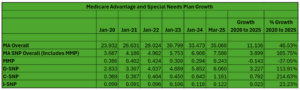
Medicare Advantage enrollment growth has slowed to roughly 1% to 3%, but Special Needs Plans (SNPs) account for about 85% of the net growth that remains. Insurers are cutting standard plans and expanding specialized ones, and the shift is strongest in rural counties.
Coverage has focused on the plan cuts at UnitedHealthcare and Humana. For anyone with exposure to Medicare Advantage payers, the question that matters is where the margin is moving, and what that does to plan availability, benefits and economics. https://rhislop3.com/medicare-advantage-whats-behind-the-pullback/
The general Medicare Advantage market is shrinking by design
UnitedHealthcare and Humana have collectively eliminated thousands of individual Medicare Advantage plans, pulling out of underperforming counties entirely. The average beneficiary now has 35 plan options, down from 39, and more than 180 counties have no general-enrollment plan at all. Millions of Americans will have fewer options during Medicare open enrollment this year | Morningstar
The two segments are moving in opposite directions:
- General plans: enrollment flat or up about 1% to 3%, margins compressed to around 3.6% by tighter CMS payment rates, and supplemental benefits scaled back.
- SNPs: about 85% of net enrollment growth, margins around 7.4% to 7.5%, and richer allowances such as food cards and lifestyle support.
Star Ratings add volatility. Humana placed 93% of its enrollees in plans rated 4 stars or higher, which secures bonus payments, while CVS/Aetna suffered sharp declines.
There’s also a cost paradox. The weighted average monthly premium is falling, from $14.37 to $12.00, but the Part D out-of-pocket cap is rising to $2,400. A senior with heavy medical usage can still come out paying more.
Chronic condition plans are the new engine for Medicare Advantage
Dual-eligible plans (D-SNPs) used to dominate the specialized market. Chronic Condition SNPs (C-SNPs), built for people with serious illness such as diabetes, chronic heart failure and cardiovascular disease, are now growing fastest, with enrollment up 45%.
The economics explain why. C-SNPs average about $23,000 in federal payment per beneficiary and run margins around 7.4%, roughly double standard HMO and PPO plans. That funds lower specialist copays, low-cost targeted drugs, and supplemental benefits for the chronically ill such as food, produce and utility support.
Two cautions. The payment and margin figures come from a single source, so treat them as approximate. And higher payments reflect sicker members and risk adjustment, so part of the margin depends on how well a plan documents and manages that risk.
D-SNP rules tighten in 2027, but not uniformly
For D-SNPs, which serve people eligible for both Medicare and Medicaid, CMS is pushing integration. Starting in 2027, aligned enrollment takes effect in many areas: a member enrolling in a D-SNP must also take the same insurer’s plan for Medicaid benefits, so care isn’t split across two companies. The scope varies by state, and it’s a question for counsel. Medicare Advantage insurers face new CMS D-SNP enrollment limits – Modern Healthcare
Full-benefit dual-eligibles can also use a monthly special enrollment period to move into highly integrated D-SNPs. That means more movement, inside tighter rules.
The Medicare Advantage/SNP shift is concentrated in rural counties
From 2016 to 2025, SNP enrollment in non-metropolitan areas grew from about 200,000 to 1.1 million. Metro enrollment grew from 1.6 million to 5.8 million. Cities still have more SNP members in absolute terms, but the rural growth rate is far higher.
Share tells the same story. Rural SNPs went from 7.9% of Medicare Advantage enrollees to 20.7%. Urban SNPs went from 10.7% to 20.0%. Rural has passed urban. Publication Details: Trends Among Medicare Special Needs Plan Enrollment in Metropolitan and Nonmetropolitan Areas – Rural Health Research Gateway
Institutional plans (I-SNPs), designed for people who need nursing home level care, are moving the same way. Rural I-SNP enrollment is growing about 13% a year against 4% in urban areas, and the urban share of I-SNP members has fallen from 72% to 66%.
Three factors explain most of it:
- Sicker populations: rural areas have higher rates of diabetes, heart disease and complications, which makes rural seniors natural C-SNP candidates.
- Carrier retreat: general plans have been leaving rural counties to save costs, and because CMS pays more for SNP members, carriers have moved to specialized plans there to stay profitable.
- Thin local care: in states with frequent rural hospital closures and fragile systems, SNPs fill gaps with telehealth and transportation benefits.
The South leads on share, the Rust Belt on choice
In the highest-penetration states, a third to nearly half of all Medicare Advantage members are in an SNP: Mississippi at 46%, Arkansas at 40%, New York at 37%, Louisiana at 36% and Florida at 33%. South Carolina, Georgia, Oklahoma and Alabama follow in the high 20s to low 30s. Several of these states haven’t expanded Medicaid, which leaves low-income seniors leaning on the supplemental benefits D-SNPs offer.
Pennsylvania, Ohio and Michigan are a different kind of hotspot. They have some of the highest counts of available plans, as carriers launch multi-county SNP options to capture rural seniors losing access to standard HMOs and PPOs.
The tension at the center of the shift
Insurers are moving toward the segment with the richest payments, which is also the segment most exposed to risk adjustment and CMS rule changes. Rural seniors, meanwhile, are losing general plan choices and relying more on SNP benefits. The shift works for insurers and for some members, but it concentrates the profit pool in one place. Medicare Advantage plan options declining for 2027 open enrollment
What to watch
These are my suggestions for anyone with Medicare Advantage exposure.
- CMS payment and risk-model updates. SNP margins depend on them more than any other segment.
- Aligned enrollment in 2027. It could reshuffle D-SNP markets state by state.
- Star Ratings. Bonus payments are separating winners from losers, as the Humana and CVS/Aetna results show.
- County exits. More than 180 counties have no general-enrollment plan, and further rural withdrawals are likely to follow the same logic.
- Local plan mix. Providers and operators in rural markets should know which plans in their area are now SNPs, because that’s where enrollment is moving.
The bottom line
Medicare Advantage is now a two-speed market. Insurers are shrinking the segment that’s squeezed and expanding the one where payments are richer. Whether SNP margins stay near double the standard plans depends on CMS: payment rates, risk adjustment and the 2027 D-SNP rules. Whichever way those go, the plans and providers that hold up will be the ones that don’t depend on today’s SNP margins staying where they are.
