
Healthcare reform is not a single bill. It is three separate changes moving through the federal system at once, and only one of them touches a skilled nursing facility’s day-to-day operations directly. Operators who treat the label as one policy risk misjudging which parts will reach their P&L and which will not.
A workable definition for post-acute providers: healthcare reform, in current practice, is the collection of federal changes affecting what must be measured and reported, how Medicare Advantage plans administer authorizations, and how Medicare reimburses post-acute services. Everything else in the headlines is noise until it changes one of those three mechanics.
IMPACT Act
The Improving Medicare Post-Acute Care Transformation Act was signed in 2014. Its purpose was standardization: requiring post-acute providers — skilled nursing facilities, home health agencies, inpatient rehabilitation facilities, and long-term care hospitals — to report a uniform set of patient assessment data across settings. I covered this in more detail here: https://rhislop3.com/impact-act-vbp-care-coordination-and-the-snf-landscape/
The intent was comparability. If a patient discharged from the hospital to post-acute care generates the same data elements no matter which setting receives them, CMS can compare quality and cost across settings and, over time, tie payment to that comparison.
IMPACT Act of 2014 Data Standardization & Cross Setting Measures | CMS
For skilled nursing operators, the operational consequence has been an ongoing obligation to submit standardized assessment data that feeds a uniform dataset. The burden is documentation and data integrity, not a rate reduction. But the burden is real, because the data now travels with the patient and is used to score the facility against others.
Medicare Advantage Prior Authorization
The change with the most direct operational effect is the regulation of Medicare Advantage prior authorization. The rule (CMS Interoperability and Prior Authorization Final Rule (CMS-0057-F) | CMS) requires MA plans to make authorization determinations within defined timeframes and to provide the clinical rationale for denials. See my July post for a policy recap: https://rhislop3.com/update-medicare-advantage-prior-authorization/
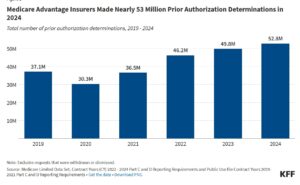
The effect on a skilled nursing facility is specific. Prior authorization controls the timing and the administrative burden of getting a stay approved. Delays in authorization convert to delays in payment and to staff time spent on appeals. The rule does not change the underlying volume of covered services. It changes how plans administer the gate.
For operators, this is a cash-flow and administrative-burden issue, and it is the single provision in the current reform environment that a facility will feel operationally within a quarter of implementation.
CMS Post-Acute Care Reform Plan
CMS has signaled an intent to move post-acute payment toward unified or site-neutral approaches across settings. The plan runs on the standardization the IMPACT Act created. Without uniform data, site-neutral payment cannot be modeled.
Post Acute Care Reform Plan | CMS
The forward implication is not a rate cut announced in a reconciliation bill. It is a slow re-engineering of how post-acute care is priced, using the uniform data already being collected. That is a multi-year progression, and the nearer-term obligation is preparation: clean assessment data, defensible documentation of medical necessity, and an understanding of how the facility scores on the measures CMS is collecting.
Forward Implications
None of this supports the claim that federal Medicaid spending reductions will directly damage skilled nursing facilities. The One Big Beautiful Bill Act (Public Law 119-21) reduces federal Medicaid spending through eligibility redeterminations, work requirements, FMAP rollbacks, and restrictions on provider taxes. Those mechanics do not lower a skilled nursing facility’s per-diem rate.
Work requirements and the standard eligibility-redetermination provisions are built around the ACA expansion population — working-age, non-disabled adults. Long-stay nursing home residents qualify for Medicaid through the aged, blind, or disabled pathway, which is statutorily exempt from work requirements, and institutional eligibility for that population is assessed under different rules than expansion-population churn. That distinction is why the reconciliation package’s largest coverage-reduction mechanisms miss the nursing home population almost entirely.
The provider-tax restriction is the only provision that touches providers directly, and its effect is second order — it changes how states finance their Medicaid programs, which can pressure state budgets and, over time, state-determined rates. To forecast a direct hit to a facility’s P&L from that provision is to claim a causal chain that is not yet in evidence.
The honest executive conclusion is this. Separate the three reforms. The IMPACT Act and the post-acute reform plan change measurement and, eventually, how services are priced against that measurement. The prior-authorization rule changes the administration of approved care. The Medicaid reconciliation package changes state financing and federal eligibility, not nursing home reimbursement. An operator who plans around the first two and monitors the third will be prepared. An operator who treats the whole thing as one indiscriminate “reform” and reacts to the headline number will be chasing the wrong risks.
Special Note: Editorial assistance and credit for much of this piece goes out to Molly Graham. Ms. Graham is an intern working with me at H2 Healthcare. She framed the piece and did much of the background work.
