
A review of Medicare Advantage prior authorization starts with an operational reality: a clinically appropriate service can be delayed, redirected, or denied before the provider ever has an opportunity to deliver it. For hospitals, skilled nursing facilities, home health agencies, hospices, and senior living operators with healthcare partnerships, prior authorization is not a minor administrative inconvenience. It is a utilization-management mechanism with direct consequences for length of stay, discharge velocity, labor productivity, cash flow, and patient trust. See my piece on this issue from a couple of years ago: CMS Offers Fix to Medicare Advantage Denials – Reg’s Blog
Issues Driving Policy
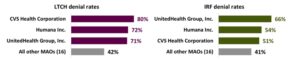
The reality today is the problem persists and just recently, in June, released an in-depth report on MA denials. The Three Largest Medicare Advantage Organizations Denied Requests for Long-Term Acute Care and Inpatient Rehabilitation at Some of the Highest Rates | Office of Inspector General | Government Oversight | U.S. Department of Health and Human Services
- Among the 19 MAOs (Medicare Advantage Organizations) in this review, the 3 largest MAOs by enrollment denied prior authorization requests for care in LTCHs and IRFs at higher rates than most of their peers in June 2024.
- When enrollees appealed, MAOs collectively overturned 36 percent of LTCH denials and 43 percent of IRF denials, indicating that some enrollees were initially denied medically necessary care. Some MAOs had much higher overturn rates than their peers. For example, IRF overturn rates ranged by MAO from 14 percent to 86 percent.
- In some cases, high denial rates were driven by contractors that denied prior authorization requests on behalf of the MAOs, many of which were later overturned on appeal by the MAO. This raises concerns about whether contractors are receiving appropriate training and oversight from MAOs.
The central policy question is no longer whether Medicare Advantage plans may use prior authorization. The question is whether plans are applying it within Medicare coverage rules, with transparent clinical criteria and reasonable turnaround times, or whether prior authorization has become a financial friction point that shifts risk onto providers and beneficiaries.
What the Federal Review Has Changed
CMS has responded to mounting concern about inappropriate denials and opaque utilization management by tightening Medicare Advantage requirements. The agency has made clear that plans must base coverage decisions on Traditional Medicare coverage rules, including applicable national and local coverage determinations. Where those rules do not address a service, plans may use internal clinical criteria, but those criteria must be evidence-based and publicly accessible.
That distinction matters. A Medicare Advantage organization is not free to create a narrower benefit simply because a service is expensive or because its internal algorithms identify the request as an outlier. Medicare Advantage is required to provide coverage that is at least equivalent to Traditional Medicare. Plans retain room to manage how care is delivered, but they do not have license to redefine what Medicare covers.
CMS has also required plans to establish utilization-management committees, conduct annual reviews of their policies, and implement continuity-of-care protections for beneficiaries who are actively receiving treatment when they enroll in a new plan. The policy direction is unmistakable: utilization management must be clinically defensible, consistently governed, and visible to the public.
The agency’s interoperability rules are equally consequential. Medicare Advantage organizations will be required to support electronic prior authorization processes and exchange specific decision information with providers under the federal implementation timetable. Technology will not solve bad clinical judgment or unreasonable plan policy. It can, however, expose delays, reduce duplicative documentation, and create a more auditable record of why a request was approved, pended, or denied.
The Review of Medicare Advantage Prior Authorization Is Not Settled
Federal reforms have improved the rules of the road, but the operating experience remains uneven. A plan can technically comply with a coverage standard while making a provider endure repeated requests for records, narrowly interpreting documentation requirements, or issuing a denial that is difficult to reverse before a discharge decision must be made.
This is particularly acute in post-acute care. A hospital attempting to place a patient in skilled nursing, home health, inpatient rehabilitation, or other lower-cost settings is managing clinical readiness, bed availability, family expectations, and payer authorization at the same time. When authorization is delayed, the hospital may retain the patient longer than medically necessary. When coverage is denied, the patient and family may face a disruptive appeal process or a less appropriate setting.
For skilled nursing and home health providers, the problem is often less about a single denial than about variation. Each Medicare Advantage plan may have different forms, portals, clinical documentation standards, delegated entities, and response patterns. The cumulative burden consumes admissions staff, case managers, clinicians, and billing personnel. It also makes census forecasting less reliable.
The financial incentive cannot be ignored. Medicare Advantage plans are paid on a capitated basis and assume responsibility for total cost of care. Appropriate utilization management can discourage unnecessary services and coordinate care. But when the process becomes excessively restrictive, the plan preserves margin by transferring administrative cost and care-delivery risk to providers. That is precisely why prior authorization deserves sustained regulatory scrutiny rather than broad assurances that plans are managing care efficiently.
Where Operators Should Focus
Providers should stop treating prior authorization as a back-office workflow separate from strategy. It is a payer-performance issue that belongs in executive dashboards and contract discussions.
Start with data. Organizations should track authorization requests by plan, service line, location, diagnosis category, approval rate, denial rate, time to decision, peer-to-peer use, appeal volume, overturn rate, and avoidable days. A blended Medicare Advantage denial rate is nearly useless. The operational question is which plans create the greatest friction, for which services, and at what point in the patient journey.
Next, distinguish between clinical denials and process denials. A denial tied to medical necessity requires a different response than one caused by a missing therapy note, incomplete medication list, incorrect portal submission, or plan-specific timing rule. If an organization cannot categorize denials, it cannot determine whether the right remedy is clinician education, workflow redesign, escalation, or contract pressure.
Post-acute operators should also assess the effect on referral conversion. A facility may appear to have a weak conversion rate when the real constraint is authorization lag from a small group of high-volume Medicare Advantage plans. That is not merely an admissions problem. It affects staffing models, occupancy, hospital relationships, and the credibility of growth projections.
Hospitals have a related obligation. Discharge planning teams should not make assumptions based on a beneficiary’s plan label alone. They need current visibility into authorization requirements, turnaround performance, and the escalation path for a delayed decision. A plan’s advertised network adequacy means little if the beneficiary cannot move through that network when care is needed.
Contracting Must Address More Than Rates
Many provider negotiations still focus overwhelmingly on reimbursement rates. That is understandable, especially under labor inflation and persistent margin pressure. Yet a rate that looks acceptable on paper can be economically inadequate if the payer imposes high administrative burden, routinely delays authorizations, or creates preventable uncompensated days.
Contract conversations should address operational performance. Providers should seek clear authorization requirements, defined turnaround expectations, a named escalation process, and regular sharing of authorization and denial data. They should also insist on clarity about delegated utilization-management vendors. A plan cannot evade accountability by placing a third party between the provider and the coverage decision.
There is a trade-off. Smaller operators may lack leverage to secure plan-specific concessions, particularly in markets where Medicare Advantage enrollment is dominant. But even when contract terms cannot be changed, disciplined measurement creates leverage for future discussions and supports targeted escalation to the plan, CMS, state regulators, or elected officials when a pattern suggests noncompliance.
The Policy Tension Ahead
Prior authorization will remain part of Medicare Advantage because the program’s economic model depends on managing utilization. Eliminating it entirely would be neither politically likely nor necessarily wise. Some services warrant review, and prospective oversight can prevent waste, duplication, and avoidable harm.
The policy failure occurs when prior authorization becomes a substitute for sound benefit design, adequate networks, or accountable care management. It is not acceptable for a plan to advertise coordinated care while forcing clinicians and families through a fragmented approval process that delays medically necessary treatment.
CMS should continue moving beyond broad policy statements toward plan-level accountability. Public reporting should make it easier to compare authorization volume, approval rates, denial reasons, decision timeliness, and appeal overturn rates across plans. Aggregated national figures are useful, but they can conceal meaningful variation in local markets and among delegated entities.
For healthcare leaders, the practical task is clear: treat Medicare Advantage prior authorization as a measurable source of clinical, financial, and reputational risk. The organizations that document its impact with precision will be better positioned to improve workflows, challenge poor payer performance, and protect patients when the authorization process becomes an obstacle rather than a safeguard.
In April of this year, Congressman John Joyce of Pennsylvania introduced the Medicare Advantage Improvement Act Dr. Joyce Introduces the Medicare Advantage Improvement Act (MAIA) | Representative John Joyce . As of today, this bill remains in committee. If it does advance, I’ll provide an update in a subsequent post.