A home health agency can miss its numbers for a quarter and recover. It can miss a key compliance signal and spend the next year dealing with repayments, audits, and reputational damage. That is why home health compliance updates deserve executive attention well beyond the compliance department.
What has changed is not simply the volume of regulation. The real shift is that compliance now sits at the intersection of reimbursement pressure, data scrutiny, staffing instability, and program integrity enforcement. In home health, those forces are no longer moving independently. CMS, Medicare contractors, and enforcement agencies are aligning payment accuracy, documentation integrity, and utilization patterns more tightly than many operators want to admit.
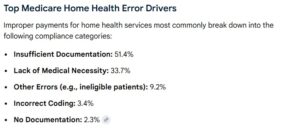
With a heightened awareness within HHS and CMS on the home care and home health fraud, enforcement action is active. Providers should pay attention via periodic review, of the OIG Home Health Compliance workplan. For example, from OIG: For CY 2014, Medicare paid home health agencies (HHAs) about $18 billion for home health services. Centers for Medicare & Medicaid Services’ Comprehensive Error Rate Testing (CERT) program determined that the 2014 improper payment error rate for home health claims was 51.4 percent, or about $9.4 billion. Recent OIG reports have similarly disclosed high error rates at individual HHAs. Home Health Compliance with Medicare Requirements | Office of Inspector General | Government Oversight | U.S. Department of Health and Human Services
Why home health compliance updates carry more weight now
The sector is operating under a harsher policy reality. Payment policy remains contested, providers continue to absorb wage inflation, and referral patterns are changing as hospitals and Medicare Advantage plans narrow networks around performance and risk. In that environment, compliance is not a defensive function. It is an operating discipline tied directly to margin protection and market access.
For years, some agencies treated compliance as a lagging review process – chart audits after the fact, annual policy refreshes, and education triggered by survey findings. That model is now too slow. Current oversight is increasingly shaped by real-time or near-real-time data analysis. Agencies with outlier behavior in utilization, coding, face-to-face documentation, or plan of care consistency are more visible than they were even a few years ago.
The practical implication is straightforward. If leadership is still relying on retrospective audit culture, it is already behind.
The compliance pressure points executives should track
The most consequential home health compliance updates are not always announced with dramatic headlines. Often, they appear through CMS rulemaking, OIG work plan activity, medical review trends, and enforcement patterns that reveal where scrutiny is heading.
One pressure point remains documentation integrity. Homebound status, skilled need, and physician or allowed practitioner documentation continue to sit at the center of payment legitimacy. Agencies often assume the biggest risk is outright missing documentation. In reality, the more common problem is internal inconsistency. The assessment says one thing, the visit note suggests another, and the plan of care reflects a level of need that is not clearly supported across the record. That inconsistency invites denials because it looks less like clinical complexity and more like weak control.
Another area is coding and episode characterization. Agencies under reimbursement pressure can drift, sometimes unconsciously, toward coding patterns that optimize payment rather than reflect clinical reality. Regulators understand that incentive structure. When coding intensity and visit utilization rise together in ways unsupported by referral mix or patient complexity, agencies can quickly attract audit attention.
Staffing creates a third compliance fault line. Labor shortages do not just affect service delivery. They affect supervision, timeliness, documentation completion, orientation, and competency validation. An understaffed agency may still be clinically committed, but if supervisory visits are delayed, care plans are stale, or missed visits are not documented and escalated properly, operational strain becomes a compliance issue.
Then there is quality reporting and survey readiness. This is where many operators underestimate the connection between quality measures and compliance visibility. Poor outcomes, odd utilization patterns, and documentation gaps can create a composite picture of organizational weakness. Regulators do not need every data point to be problematic. They need enough signals to justify a closer look.
Medicare Advantage adds a different kind of risk
Traditional Medicare compliance remains central, but agencies that have grown through Medicare Advantage contracts face a more complicated environment than they sometimes acknowledge. MA plans introduce prior authorization requirements, narrower medical necessity interpretations, and contractual obligations that can be operationally punishing.
The compliance issue here is not just claim denial. It is whether agencies are building workflows that align payer authorization, clinician documentation, and actual delivered care. If those do not match, the organization may face both payment disputes and allegations of submitting claims inconsistent with authorization parameters. That is not merely a contracting headache. It can become a larger governance problem.
What smarter agencies are doing differently
The agencies handling home health compliance updates best are not simply buying more software or expanding policy manuals. They are changing how information moves inside the organization.
First, they are treating compliance signals as management signals. If denied claims are rising in one branch, if utilization is materially different by clinician group, or if late documentation is concentrated in a specific market, those are not isolated technical issues. They are indicators of leadership, training, or culture problems. Executive teams that frame compliance this way tend to respond earlier and more effectively.
Second, they are narrowing the gap between clinical operations and revenue cycle. In too many organizations, clinical teams document care, coding teams translate the record, and billing teams submit claims with limited strategic integration. That structure is common, but it creates fragmentation. Better-performing agencies are using interdisciplinary review to test whether the clinical story, coding profile, and claim submission actually make sense together.
Third, they are paying closer attention to referral-source risk. Hospital discharge pressure can create subtle compliance drift. Agencies may accept borderline patients, start care before documentation is fully aligned, or stretch the interpretation of skilled need to preserve referral relationships. That may help near-term census, but it weakens long-term defensibility. The more sophisticated operators know that not all volume is good volume.
Technology helps, but only if governance is stronger
There is a tendency in healthcare to believe that compliance technology will solve compliance discipline. It will not. Analytics platforms can identify outliers, flag incomplete records, and benchmark branch performance. Those tools matter. But they are only as effective as the governance structure behind them.
If leaders do not define escalation thresholds, assign accountability, and act on findings consistently, dashboards become expensive wallpaper. The issue is not whether an agency has data. It is whether management is willing to confront what the data says.
The policy backdrop operators should not ignore
A serious reading of current oversight trends suggests that home health is still viewed through a program integrity lens in Washington. That perspective shapes everything from payment recalibration debates to audit targeting. Agencies may disagree with the assumptions embedded in that lens, but ignoring it is a strategic mistake.
Federal policymakers remain concerned about utilization growth, coding behavior, and the broader sustainability of Medicare spending. That means home health providers should expect ongoing scrutiny, not a lighter touch. Even when rules are framed as payment reform or quality improvement, they often carry embedded compliance implications.
This matters especially for multi-state operators, private equity-backed platforms, and acquisitive agencies. Scale can improve infrastructure, but it also increases visibility. The larger and more data-visible an organization becomes, the less room it has for branch-level inconsistency or undocumented workarounds. Growth without compliance standardization is not a strategy. It is deferred exposure.
For readers of RHislop3.com, this is the larger point worth emphasizing: compliance in home health is no longer a back-office obligation tied narrowly to survey outcomes. It is part of how government, payers, and markets judge whether an organization deserves capital, referrals, and reimbursement stability.
How to read home health compliance updates strategically
Not every update carries the same weight. Some are technical clarifications. Others signal a genuine enforcement turn. The question executives should ask is not only, “What changed?” It is, “What behavior is this policy trying to constrain?”
That framing helps separate noise from substance. If a new requirement increases documentation specificity, ask whether regulators are responding to known abuse patterns or to widespread sloppiness in clinical records. If a contractor expands medical review in a region, ask what utilization pattern likely triggered it. If quality and payment policy move closer together, assume data triangulation is becoming more sophisticated.
This approach also keeps leadership from overreacting. Not every compliance update requires a company-wide overhaul. Some require targeted education, tighter branch monitoring, or a revised physician documentation workflow. The trade-off is resource allocation. Overbuild compliance infrastructure and you burden operations. Underinvest and you create avoidable financial risk. Mature organizations know the answer is rarely maximalism. It is precision.
The agencies that will perform best over the next several years are the ones that stop treating compliance as a separate conversation. In home health, compliance is now strategy expressed through documentation, staffing discipline, utilization management, and executive accountability. Leaders who understand that will be better positioned when the next audit cycle, payment adjustment, or policy shift arrives – and less surprised when it does.
The smart move right now is not to wait for the next headline. It is to build an organization that can recognize a compliance signal early, interpret it correctly, and respond before regulators do it for you.