
When hospice enrollment spikes in markets with no matching rise in terminal illness, executives should not treat that as noise. Medicare hospice fraud is not a niche compliance issue buried in enforcement bulletins. It is a structural problem that exposes weaknesses in eligibility oversight, payment design, provider screening, and the government’s ability to distinguish legitimate end-of-life care from revenue harvesting.
That matters far beyond the hospice segment. Fraud in a benefit built around dignity, trust, and clinical judgment damages Medicare’s credibility, increases scrutiny across post-acute care, and invites blunt regulatory responses that affect compliant providers just as much as bad actors. For operators, investors, and policy leaders, the real question is not whether fraud exists. It is why the system still makes it possible at scale.
Why Medicare hospice fraud keeps resurfacing
Hospice has long carried a unique vulnerability in the Medicare program. Eligibility depends on physician certification that a patient is terminally ill with a life expectancy of six months or less if the disease runs its normal course. That is a clinical standard, but it is also a subjective one in many cases, particularly with non-cancer diagnoses, functional decline, dementia, and chronic frailty.
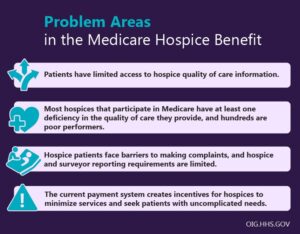
That gray area is where abuse can flourish. A payment model built on per diem reimbursement creates a straightforward economic temptation. Providers can generate attractive margins when they enroll patients with limited acute needs, keep visit intensity low, and retain beneficiaries for extended lengths of stay. In a properly governed hospice, that tension is managed by clinical integrity, documentation discipline, and ethical leadership. In a poorly governed or intentionally abusive organization, it becomes a business model.
This is why enforcement patterns tend to cluster around similar allegations. Patients who are not truly eligible are recruited or steered into hospice. Medical records are shaped to support terminal status after the fact. Certifications become rubber stamps. Marketing practices drift into inducement territory. The fraud is not always cinematic. Often it looks administrative, coded, and operationally efficient.
Back in February/March of last year, I wrote a three-part series on Medicare Hospice and Home Health fraud. Part 3 is below and includes links to Parts 1 and 2.
What became interesting is that when I wrote the three-part series (above) analyzing Medicare hospice and home health fraud, a subsequent congressional letter to HHS’s Office of Inspector General — investigating suspected systemic fraud among home health agencies and hospices in Los Angeles County — cited my analysis directly as a reference point. This was just the beginning of what continues to roll out. Attorney General Bonta Dismantles Los Angeles Hospice Fraud Ring Responsible for $267 Million in Fraud, 21 Charged | State of California – Department of Justice – Office of the Attorney General
The business mechanics behind fraud
The industry should be candid about the incentives. Fraud rarely appears because rules are unclear in the abstract. It appears because a subset of organizations sees a predictable path to monetizing weak controls.
In hospice, that path can include targeting beneficiaries who are dually eligible, cognitively impaired, socially isolated, or living in congregate settings where referral influence is easier to exercise. It can involve paying marketers based on census growth, exploiting language barriers, or enrolling patients who believe they are signing routine care paperwork rather than electing the hospice benefit. Some schemes are overtly criminal. Others operate in the space between aggressive census strategy and clear false claims exposure.
Geography matters as well. Certain markets show persistent concern around newly formed hospices, rapid license growth, and ownership structures that make accountability harder to trace. When entry barriers are low and oversight is slow, opportunistic actors can scale before regulators catch up. That lag is not incidental. It is part of the economics.
For compliant providers, this creates a frustrating asymmetry. High-integrity hospices invest in medical director involvement, interdisciplinary documentation, audit readiness, and referral discipline. Fraudulent operators can post growth by cutting exactly those controls. In the short term, bad behavior can look like market success.
What CMS and enforcement agencies are really signaling
When CMS increases hospice scrutiny, the industry should read the signal correctly. This is not just about recovering overpayments. It is about preserving the legitimacy of a benefit that remains politically and clinically important.
Recent years have shown a more aggressive posture around hospice program integrity, including enhanced oversight in selected states, concern about new provider entry, and closer review of ownership patterns and billing anomalies. The Office of Inspector General, the Department of Justice, and Medicare contractors have all highlighted recurring vulnerabilities. The message is direct: hospice is now a higher-risk policy zone.
That has two implications. First, enforcement will continue to focus on outliers in live discharges, long lengths of stay, diagnosis mix, and referral relationships. Second, regulators are increasingly willing to treat fraud concerns as justification for broader enrollment restrictions and screening measures. That is a rational policy response when targeted oversight is not keeping pace, but it creates collateral burden for legitimate providers.
This is the larger policy failure. Medicare too often responds after fraud patterns are already entrenched. Instead of building real-time detection and disciplined market entry standards on the front end, it relies on audits, investigations, and prosecutions on the back end. By then, beneficiaries have already been harmed and the trust damage is done.
Medicare hospice fraud is also a governance issue
Boards and executive teams should not relegate this topic to compliance officers alone. Medicare hospice fraud is a governance issue because the warning signs are often visible in operating data long before they appear in an enforcement letter.
A hospice with unusually high median length of stay, low visit intensity, aberrant revocation patterns, or a census strategy overly dependent on third-party marketers should trigger leadership-level questions. So should referral concentration from a narrow set of sources, sudden expansion into unfamiliar geographies, and documentation practices that look standardized rather than individualized.
Private equity ownership is not synonymous with fraud, but the policy community is right to examine whether financial engineering and growth pressure can heighten risk in sectors where eligibility is judgment-based and public payment is relatively stable. The better question is not who owns the asset. It is whether the governance model rewards durable compliance or merely scales reimbursement capture.
Sophisticated organizations already understand this. Enterprise risk in hospice now includes billing integrity, referral integrity, ownership transparency, and the defensibility of clinical eligibility decisions. If leadership is not reviewing those issues with the same seriousness given to labor cost or rate pressure, they are misreading the market.
The operational consequences for legitimate hospice providers
Fraud in one corner of the sector changes operating conditions for everyone else. Expect tighter surveys, more claim review friction, more skepticism from hospital discharge planners, and greater reputational vulnerability in community-based referral channels. Even when a provider is clinically strong, the burden of proving legitimacy rises after repeated headlines and enforcement actions.
This creates a difficult trade-off. Regulators need stronger controls, but excessive administrative friction can interfere with timely access for patients who genuinely need hospice care. Operators know the reality: every new documentation requirement, enrollment checkpoint, or prepayment review mechanism has a labor cost and a service consequence.
That is why blunt reform is rarely the best reform. The sector does not need performative crackdowns that swamp compliant hospices in paperwork while sophisticated fraud rings adapt. It needs targeted screening of new entrants, data-driven identification of aberrant patterns, tighter oversight of marketer relationships, and faster intervention when geographic anomalies emerge.
The industry should also support stronger physician accountability around certifications. Eligibility is central to benefit integrity. If certifications are repeatedly unsupported, there should be meaningful consequences. A system that punishes billing entities but ignores recurring certifier behavior is leaving one of the core control points exposed.
What smart operators should do now
The practical response is not panic. It is disciplined self-assessment. Hospice leaders should assume the enforcement environment will remain intense and that external stakeholders will increasingly judge organizations by whether they can demonstrate not just compliance infrastructure, but compliance culture.
That means testing admission documentation against actual prognostic support, auditing long-stay cases with real clinical skepticism, and evaluating whether growth patterns would look reasonable to an outside reviewer. It also means taking a hard look at compensation design. If census growth is rewarded without equal weight on eligibility quality and documentation integrity, leadership is creating avoidable risk.
Operators in adjacent sectors should pay attention as well. Hospitals, skilled nursing facilities, assisted living operators, and physician groups all need stronger referral governance. If a referral source consistently sends patients to a hospice with questionable patterns, investigators may eventually ask what the source knew and when it knew it. Passive ignorance is not much of a defense in today’s environment.
For investors and lenders, hospice due diligence should move well beyond historical margin and census trends. Diagnosis mix, live discharge rates, referral concentration, leadership turnover, and compliance staffing deserve close scrutiny. An asset can look operationally attractive right up until the point that repayment demands, suspended payments, or False Claims Act exposure change the valuation thesis overnight.
The hospice benefit remains essential. Families need it, clinicians value it, and the broader healthcare system depends on it to support patient-centered end-of-life care. But preserving that benefit requires more than praising its mission. It requires confronting the uncomfortable truth that weak oversight and misaligned incentives have allowed too much room for abuse. The organizations that will be strongest in this environment are the ones that treat integrity not as messaging, but as operating strategy.