
Every year, the release of Medicare insolvency projections triggers a familiar cycle: headlines warn that Medicare is running out of money, advocates insist benefits are safe, and operators are left sorting politics from payment reality. For healthcare executives, the real question is not whether Medicare disappears. It will not. The real question is how projected trust fund depletion will reshape reimbursement policy, provider margins, and federal decision-making long before any formal insolvency date arrives.
Reform is not optional as the present course creates a date certain when current funding mechanisms, left unaltered, fail to meet program expenditures. Today, this would occur in 2033. Beyond Insolvency: The Bigger Picture of Medicare’s 2026 Financial Outlook | Medicare Policy Initiative
What most people do not understand is that Medicare is not a single financing bucket. It is a set of programs financed in different ways, with very different implications for providers and beneficiaries. When analysts refer to insolvency, they are usually talking about the Hospital Insurance trust fund, which supports Medicare Part A. That includes inpatient hospital care, skilled nursing facility benefits after a qualifying stay, some home health episodes, and hospice. Parts B and D are structured differently, with ongoing general revenue support and beneficiary premiums – basically never solvent without government issued debt.
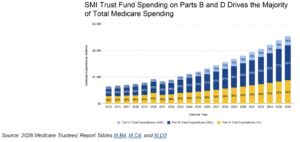
So, when Medicare insolvency projections move forward or backward by a few years, the operational signal is not that Medicare checks suddenly stop. It is that federal policymakers face rising pressure to contain costs inside a politically protected program or alternatively, restructure financing methods. As I have written many times, the solvency problem is solved only with benefits restructured, internal coverage and payment mechanics reformed (e.g., no longer paying Medicare Advantage more than the cost of traditional Medicare/fee-for-service coverage), and financing methods reinvented.
What Medicare insolvency projections actually measure
The phrase sounds broader than it is. In most policy discussions, Medicare insolvency projections refer to the estimated year in which the Part A trust fund would no longer have sufficient reserves to pay full scheduled benefits. At that point, incoming payroll tax revenue would still cover a substantial share of obligations, but not all of them.
That is a crucial nuance for operators and investors. Insolvency in this context is not bankruptcy in the private-sector sense. It is a statutory financing shortfall. The federal government would still be collecting dedicated Medicare taxes. Congress would still have options. Providers would still be dealing with Medicare. But a depletion event would force a sharper fiscal confrontation over who absorbs the gap.
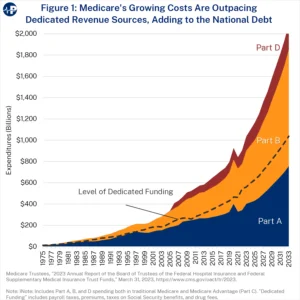
- Medicare is the single largest driver of federal deficits, with spending greatly, exceeding dedicated funding and the program increasingly relying on general revenues. As the U.S. runs a deficit fiscal year to fiscal year (in FY 2026 projected at $2 trillion), funding programs like Medicare comes from U.S. issued debt (Treasury securities).
The annual Trustees Report is the central reference point, and those projections move based on healthcare spending growth, labor market conditions, wage trends, utilization, demographics, and legislative changes. A stronger economy can improve near-term financing. Lower utilization can buy temporary relief. But the structural drivers remain stubborn: an aging population, longer life expectancy, and a shrinking ratio of workers paying payroll taxes relative to beneficiaries drawing coverage.
Why the projections matter before the deadline hits
Healthcare leaders sometimes dismiss trust fund depletion dates because Congress has historically stepped in when federal programs approach a fiscal cliff. That instinct is understandable, but it can also be shortsighted. Policy does not wait for the cliff. It reacts to the trajectory.
When Medicare insolvency projections worsen, Washington does what Washington always does under fiscal stress: it looks for offsets, efficiencies, coding scrutiny, site-neutral payment ideas, and program integrity initiatives that save federal dollars without inviting direct benefit cuts. In plain terms, providers become part of the financing conversation.
That is already visible across the sector. Hospitals face recurring pressure around outpatient payment parity and uncompensated care assumptions. Skilled nursing operators navigate a reimbursement framework that is perpetually vulnerable to recalibration. Home health agencies have seen how quickly CMS can frame payment adjustments as budget neutrality corrections. Medicare Advantage plans, though funded differently than Part A trust fund accounting alone would suggest, are also under growing scrutiny because benchmark design, risk adjustment behavior, and utilization management all feed the broader debate over Medicare spending discipline.
For post-acute and senior care leaders, the insolvency narrative is not abstract federal theater. It is a political justification for more aggressive payment oversight.
The real policy question is not whether Medicare gets saved
It will. The federal government is not going to allow Medicare to implode on the watch of any administration or Congress. The better question is what kind of fix emerges, and who pays for it.
There are only a few levers available. Policymakers can increase payroll taxes, shift more costs to beneficiaries, reduce provider payments, expand general revenue support, raise eligibility parameters, or pursue some combination of those options. None is painless. All carry political risk.
That is why the eventual response is likely to be incremental, uneven, and heavily shaped by lobbying strength. Congress tends to prefer patches that spread pain diffusely rather than reforms that concentrate it visibly. For providers, that usually means a series of payment constraints, compliance obligations, and model adjustments rather than one dramatic restructuring.
Hospitals and post-acute providers should not assume they will be treated equally in that process. Acute care has political influence, but it also represents a large spending target. Skilled nursing has lower prestige in Washington and remains exposed to enforcement narratives tied to quality and ownership. Home health is clinically attractive and cost efficient in many scenarios, but that has not prevented repeated rate pressure. Hospice remains politically sensitive because of its value to families, yet it is also vulnerable to integrity crackdowns. Sector-specific exposure will depend on how policymakers frame savings opportunities.
What healthcare operators should watch in the next round of projections
The headline depletion year matters, but it is not the only signal. Executives should pay closer attention to what is driving the revised estimate. If projections improve because of temporary utilization suppression or favorable short-term wage growth, that is not the same as structural stabilization. If projections worsen due to persistent spending acceleration, the policy response becomes more urgent.
It also matters whether federal officials pair trust fund warnings with a stronger message around value-based care, fraud enforcement, risk adjustment controls, or site-neutral reform. Those are not separate conversations. They are mechanisms for fiscal management.
For senior living and post-acute leaders, another key issue is the spillover effect into Medicaid and Medicare Advantage. When traditional Medicare financing pressure intensifies, states and plans adapt their own posture. Medicaid programs often become more defensive in rate setting. Medicare Advantage plans become more selective in network design, prior authorization standards, and post-acute utilization management. The stress does not stay contained inside a trust fund report.
That is where executive teams need a broader lens. A Medicare financing problem rarely stays a Medicare-only problem.
Medicare insolvency projections and the provider strategy mistake
The most common strategic mistake is treating Medicare sustainability as a distant policy debate rather than a current operating constraint. If your organization depends heavily on Medicare reimbursement, the projections should already be part of scenario planning.
That does not mean panic. It means discipline. Operators should understand their service line exposure by payer and margin, assess sensitivity to rate compression, and revisit whether their care model can withstand tighter utilization review and slower payment updates. In sectors where labor remains expensive and occupancy recovery is uneven, even modest Medicare pressure can compound quickly.
Boards should be asking sharper questions. How dependent is the enterprise on fee-for-service Medicare? Where is Medicare Advantage changing the effective rate environment? Which services are most vulnerable to policy reframing as avoidable, excessive, or misaligned with value? Those are no longer technical reimbursement questions. They are strategic finance questions.
Investors and lenders should ask similar ones. In a market still trying to price regulatory risk correctly, Medicare financing pressure is part of the credit story. It affects earnings visibility, operator resilience, and the credibility of long-range forecasts.
The politics will stay messy, but the direction is clear
Do not expect a clean grand bargain. Medicare has been politically untouchable for decades, and that makes genuine reform harder, not easier. Both parties are more comfortable accusing the other side of cutting Medicare than explaining how to finance it sustainably.
So the likely path is familiar: technical adjustments, selective revenue measures, reimbursement drag, and more aggressive oversight sold as stewardship. That may postpone a larger reckoning, but it will still shape provider economics in the meantime.
For readers of RHislop3.com and others operating in senior services and healthcare delivery, the takeaway is straightforward. Medicare insolvency projections are not just fiscal trivia for policy circles. They are early warning indicators for payment pressure, regulatory activism, and market repositioning. The depletion date itself may move. The strategic implications are already here.
The smartest organizations will not wait for Congress to settle the argument. They will build models that assume Medicare remains essential, under strain, and increasingly contested as a source of federal savings.